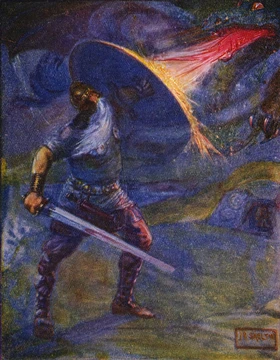
The Dream of the Rood
Old English dream poem about the Crucifixion from the Cross's perspective.
The Dream of the Rood is a Christian poem from the Old English literary tradition and belongs to the dream-poetry genre. It is composed in alliterative verse, as is typical of most Old English poetry. The term "Rood" comes from the Old English word *rōd*, meaning "pole" or, more specifically, "crucifix." The poem is preserved in the Vercelli Book, a manuscript dated to the tenth century, and may be as old as the eighth-century Ruthwell Cross. It is regarded as one of the oldest surviving works of Old English literature.
The poem uses a dream as its framing device: the narrator falls asleep and hears a speech delivered by the Cross on which Jesus was crucified. The work is commonly divided into three sections. In the first (lines 1–27), the narrator sees the Cross in his vision. He notices it is covered with gems but also stained with blood, and he feels wretched in comparison to its glory. In the second section (lines 28–121), the Cross recounts the events of Jesus’ death from its own perspective. It describes being cut down by enemies and carried away, only to learn it will bear Christ, not a criminal. The Lord and the Cross become united, standing together as victors and enduring immense pain for humanity. Both Christ and the Cross are pierced with nails, mocked, and tortured. After the crucifixion, the Cross is resurrected and adorned with gold and silver, honored above all trees just as Jesus is honored above all men. The Cross then commands the visionary to share what he has seen. In the third section (lines 122–156), the author reflects on the vision. The dream ends, and the man is left alone, praising God and hoping for eternal life, longing to be near the glorious Cross again.
Scholars have proposed different structural readings of the poem due to its many components and unclear divisions. Faith H. Patten divides it into three parts based on who is speaking: an introductory section (lines 1–26), the speech of the Cross (lines 28–121), and a closing section (lines 122–156). However, this approach does not account for thematic unity or tonal shifts. Constance B. Hieatt distinguishes portions of the Cross’s speech by speaker, subject, and verbal parallels, resulting in a prologue (lines 1–27), Vision I (lines 28–77, the history of the Rood), Vision II (lines 78–94, explanation of the Rood’s glory), Vision III (lines 95–121, the Rood’s message to manki
- Manuscript
- Vercelli Book (tenth century)
- Earliest possible date
- Eighth century (Ruthwell Cross)
- Genre
- Dream poetry, Christian poem
- Verse form
- Alliterative verse
- Number of lines
- 156
- Author
- Unknown; possibly multiple authors
- Surviving manuscript location
- Vercelli, Italy
Lore & Background
The poem is framed as a dream vision. The narrator sees a glorious Cross covered with gems but also stained with blood. The Cross then gives a speech recounting the Crucifixion from its own perspective: it was cut down by enemies, carried away, and then became the instrument of Christ's death. The Cross and Christ are portrayed as one—both pierced with nails, mocked, and tortured. After the Resurrection, the Cross is adorned with gold and silver and honored above all trees. The Cross charges the visionary to share what he has seen. The vision ends, and the man gives praise to God, filled with hope for eternal life and desire to be near the Cross again.
Reader's Guide
The Dream of the Rood is significant as one of the oldest extant works of Old English literature and a key example of Christian dream poetry. Its preservation in the Vercelli Book and its possible connection to the eighth-century Ruthwell Cross make it a crucial artifact for understanding the intersection of Christian and pre-Christian literary traditions in early medieval England. The poem's structure has been variously divided by scholars: some see three parts based on speaker (introductory section, speech of the Cross, closing section), while others propose more complex divisions based on thematic unity or concentric circles. The author is unknown, and nineteenth-century attempts to attribute the poem to Cædmon or Cynewulf are no longer accepted. Recent metrical, lexical, and syntactical evidence suggests composite authorship by at least two different poets. The poem also has analogues in a riddle by Tatwine and in the Brussels Cross inscription, which contains a distich resembling lines in The Dream of the Rood. Its legacy lies in its vivid, first-person account of the Crucifixion from the Cross's perspective, blending heroic and devotional motifs.
Did You Know?
- The poem is preserved in the tenth-century Vercelli Book, which also contains homilies and five other religious poems.
- Parts of the crucifixion narrative appear on the eighth-century Ruthwell Cross, an 18-foot free-standing Anglo-Saxon cross.
- The author is unknown, and some scholars argue the poem is the work of multiple authors.
- A similar representation of the Cross appears in a riddle by the eighth-century Anglo-Saxon writer Tatwine.
More in English folklore 1-24
Spotted an error? Know more?
This is a living reference — every entry is fact-audited, and reader corrections feed straight into our audit queue. Suggest an edit · See this site's audit record