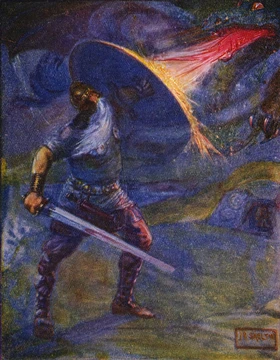
The Buried Moon
A fairy tale of a moon trapped in a bog.
The tale "The Buried Moon," also called "The Dead Moon," appears in Joseph Jacobs' *More English Fairy Tales*. Unlike most fairy tales, it has few known versions and feels more like a myth. Marie Clothilde Balfour collected it from the North Lincolnshire Carrs in the Ancholme Valley. Because of its unusual nature, many questioned whether it was truly a folk tale, but Balfour's published notes were later accepted as reliable. The story may hint at ancient moon worship and is classified as ATU 1336.
In the story, the Carland was once full of bogs. When the moon shone, it was safe to walk there, but when she was absent, evil creatures like bogies came out. Hearing of this, the moon put on a black cloak over her yellow hair and went to see for herself. She fell into a pool, where a snag trapped her. A man approached the pool; the moon struggled until her hood fell off, and her light guided him to safety and scared off the evil things. But when the hood fell back over her hair, the creatures returned, trapping her under a large stone. They set a will-o'-the-wyke on the cross-shaped snag to keep watch. The moon stopped rising, and people wondered what had happened. The man she saved told his story. A wise woman then sent people into the bog to find a coffin (the stone), a candle (the will-o'-the-wyke), and a cross (the snag); the moon would be nearby. They followed her advice and freed the moon. Since then, the moon has shone brighter over the boglands than anywhere else, and the evil things fled the Carland.
Modern adaptations include Charles de Lint's retelling "The Moon Is Drowning While I Sleep." The webcomic *No Rest for the Wicked* uses elements of the tale as a starting point, with an insomniac princess searching for the missing moon. French power metal band Wildpath adapted the story musically on their album *Underneath*, releasing a music video for the song "Buried Moon" in 2012.
- catalogued_as
- ATU 1336
- collected_by
- Marie Clothilde Balfour
- region
- North Lincolnshire Carrs, Ancholme Valley
- included_in
- More English Fairy Tales by Joseph Jacobs
- type
- Fairy tale
Lore & Background
The tale is set in the Carland, a region filled with bogs. When the moon shone, it was safe to walk, but when she did not, evil bogies emerged. The moon, hearing of this, pulled on a black cloak over her yellow hair and went to see for herself. She fell into a pool, and a snag bound her there. She saw a man approaching and fought to free herself; the hood fell off, and her light helped the man escape and scared off evil creatures. She struggled until the hood fell back, and evil things trapped her under a stone with a will-o'-the-wyke sitting on a cross-shaped snag to keep watch.
Reader's Guide
The Buried Moon is significant as a rare fairy tale with mythological overtones, collected from a specific English region. Its inclusion in Joseph Jacobs' More English Fairy Tales helped preserve a local folk narrative that might otherwise have been lost. The tale's unusual characteristics initially caused doubt about its authenticity, but Balfour's published notes were found reliable. The story has inspired modern adaptations, including a retelling by Charles de Lint, elements used in the webcomic No Rest for the Wicked, and a musical adaptation by French power metal band Wildpath on their album Underneath, with a music video released in 2012. The tale may also evidence a form of moon worship.
Did You Know?
- The tale was collected by Marie Clothilde Balfour from the North Lincolnshire Carrs in the Ancholme Valley.
- Its unusual characteristics made many people doubt its origins as a fairy tale.
- The story may evidence a form of moon worship.
- French power metal band Wildpath released a music video for their song Buried Moon in 2012.
Frequently Asked Questions
What is 'The Buried Moon' (also called 'The Dead Moon')?
It is a short English folk narrative in which the moon becomes entombed in a bog, removing its protective light from the landscape. The tale was published in Joseph Jacobs' *More English Fairy Tales* and carries the ATU index number 1336.
Who collected 'The Buried Moon' and from where?
Marie Clothilde Balfour recorded the story from tellers in the North Lincolnshire Carrs, specifically the Ancholme Valley. Because so few variants survive and the text reads more like a mythic fragment than a conventional fairy tale, some scholars initially questioned its folk credentials, but Balfour's field notes were ultimately judged reliable.
What role does the moon play in the story?
The moon serves as the sole source of safe passage across the bog-choked Carland; while its light is visible, travelers can cross without danger. Once the moon is buried in the mire, that protection is lost and the terrain becomes a lethal trap.
Why do fans and scholars consider 'The Buried Moon' significant?
It is one of the very few English tales that appears to preserve a trace of pre-Christian lunar veneration, lending it a mythic gravity most fairy tales lack. Its extreme rarity in the oral record and its atypical structure make it a key reference point for anyone tracing how celestial worship filtered into English folklore.
How does 'The Buried Moon' end?
The narrative closes with the moon still trapped beneath the bog, its light gone for the walkers of the Carland. There is no rescue or restoration—the loss is permanent, which is what gives the tale its stark, mythic finality.
More in English folklore 1-24
Spotted an error? Know more?
This is a living reference — every entry is fact-audited, and reader corrections feed straight into our audit queue. Suggest an edit · See this site's audit record