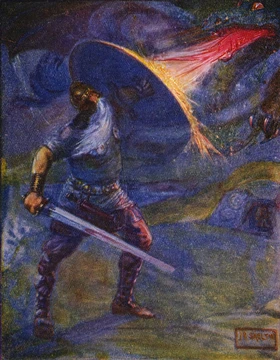
Blackbeard in popular culture
Notorious English pirate of the early 18th century.

Wikipedia / Wikimedia Commons
Edward Teach, the English pirate known as Blackbeard (c. 1680 – 22 November 1718), terrorized the West Indies and the eastern American colonies in the early 1700s. He commanded the 200-ton frigate Queen Anne's Revenge (originally the Concord) and was killed on 22 November 1718 at Ocracoke Island during a fierce fight with Virginia troops. This real-life figure has since turned up in countless books, TV shows, films, comics, video games, and songs.
In literature, Tim Powers’ 1987 novel *On Stranger Tides* has Blackbeard (called Edward Thatch) teaming up with a French puppeteer, a pirate captain, and an Englishwoman and her father to find the Fountain of Youth in Florida in 1718. After finding it, Blackbeard hides the Queen Anne's Revenge and sails the Adventure into battle at Ocracoke Inlet, knowing he will die there but wanting a legendary end. He fights through many wounds, and when he finally dies, his head is cut off and hung on the bowsprit. His blood falls into the sea except for one drop, which is part of a resurrection spell to make him immortal. He later returns under a new identity, confronts the puppeteer Jack Shandy, and tries to marry Beth Hurwood, but Jack and Beth use their magic to defeat him. In Rick Riordan’s *The Sea of Monsters*, Blackbeard and his crew are turned into guinea pigs on Circe’s island. Percy and Annabeth accidentally turn them back, then escape on the Queen Anne's Revenge, leaving Blackbeard stranded. He is revealed as a demigod son of Ares. Later books mention he destroyed Circe’s island and escaped with Reyna and Hylla Ramírez-Arellano as his slaves before they forced him to let them go. Blackbeard also appears in Neal Stephenson’s *The System of the World*, Wayne Thomas Batson’s *Isle of Fire* (as a young quartermaster), Stephen Vincent Benét’s short story “The Devil and Daniel Webster” (as a juror), and Nicole Castroman’s 2016 novel *Blackhearts* (about his younger days).
On television, Malachi Throne played Blackbeard’s ghost in a 1968 *Voyage to the Bottom of the Sea* episode. Gerry Wain portrayed him in the 1968 *Doctor Who* serial *The Mind Robber*. Hori Ahipene played him in two episodes of the 2000 series *Jack of All Trades*. In the 2001 cartoon *Time Squad*, Roger Rose voiced a Blackbeard more concerned with the environment than piracy; he ends up in a cell next to Mahatma Gandhi. James Purefoy starred as Blackb
- born
- c. 1680
- died
- 22 November 1718
- field
- Piracy
- nationality
- English
- known_for
- Captain of the Queen Anne's Revenge; notorious pirate of the West Indies and American colonies
Lore & Background
Edward Teach, better known as Blackbeard, was a notorious English pirate who operated around the West Indies and the eastern coast of the American colonies during the early 18th century. He captained the Queen Anne's Revenge, a 200-ton frigate originally named the Concord, and died in a fierce battle with troops from Virginia on November 22, 1718, at Ocracoke Island.
Reader's Guide
Blackbeard's legacy is primarily shaped by his fearsome reputation and dramatic death, which have made him a recurring figure in popular culture. In literature, he appears in Tim Powers's 1987 novel On Stranger Tides, where he seeks the Fountain of Youth and uses resurrection magic. Rick Riordan's The Sea of Monsters depicts him as a demigod son of Ares stranded on Circe's island. Television portrayals range from the 2005 BBC miniseries Blackbeard to the 2014 series Crossbones and the 2018 DC's Legends of Tomorrow. Film adaptations include Blackbeard's Ghost (1968) and Pirates of the Caribbean: On Stranger Tides (2011), where he is a brujo wielding a sword that controls his ship. In comics, he appears in One Piece and DC Comics. Video games such as Assassin's Creed IV: Black Flag and Sid Meier's Pirates! feature him as a character. These varied depictions often emphasize his legendary status, magical abilities, or historical notoriety, cementing Blackbeard as an enduring symbol of piracy.
Did You Know?
- Blackbeard died in a fierce battle with troops from Virginia on November 22, 1718, at Ocracoke Island.
- He captained the Queen Anne's Revenge, a 200-ton frigate originally named the Concord.
- In Tim Powers's novel On Stranger Tides, Blackbeard uses resurrection magic to achieve immortality.
- In Rick Riordan's The Sea of Monsters, Blackbeard is depicted as a demigod son of Ares.
Frequently Asked Questions
Who is Blackbeard in popular culture?
He is the legendary English pirate Edward Teach, a terror of the West Indies and eastern American colonies in the early 1700s, who has since become one of the most frequently recycled villain archetypes across literature, film, television, comics, video games, and music.
What role does Blackbeard typically fill in popular culture adaptations?
He most often appears as a fearsome pirate captain commanding the 200-ton frigate Queen Anne's Revenge, and in fantasy reimaginings like Tim Powers' 1987 novel On Stranger Tides he is recast as Edward Thatch, a long-lived pirate who teams up with a French puppeteer and another pirate captain.
How does Blackbeard's story end in the canon that most adaptations draw from?
He was slain on 22 November 1718 at Ocracoke Island during a fierce battle with Virginia troops, and that violent death remains the standard ending for his character in most popular culture retellings.
Why is Blackbeard such a central figure in popular culture?
His notoriety as an English pirate of the early 18th century, combined with his iconic ship and dramatic death, made him a ready-made symbol of the golden age of piracy that storytellers across every medium have drawn on for over two centuries.
What is the Queen Anne's Revenge in Blackbeard stories?
It was his flagship, a 200-ton frigate originally named the Concord, and in popular culture it frequently anchors sea-battle set pieces, treasure-quest plots, and the climactic showdown that brings his story to a close.
More in English folklore 1-24
Spotted an error? Know more?
This is a living reference — every entry is fact-audited, and reader corrections feed straight into our audit queue. Suggest an edit · See this site's audit record