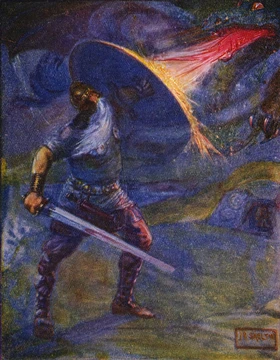
The dragon (Beowulf)
First fire-breathing dragon in English literature.
The dragon in the Old English poem Beowulf is the third and final monster encountered by the hero. It is the earliest example in English literature of a typical European dragon and the first literary depiction of a fire-breathing dragon. The dragon's fight with Beowulf, occurring near the end of the poem, is a central event that symbolizes the hero's stand against evil and destruction, and its legacy influenced later fantasy works, including J. R. R. Tolkien's The Hobbit.
- field
- Anglo-Saxon literature
- known_for
- First fire-breathing dragon in English literature; final antagonist of Beowulf
- nationality
- Geatish (mythological)
Lore & Background
The dragon is awakened and angered when a slave steals a jeweled cup from its lair. In retaliation, the dragon mercilessly burns the homes and lands of the Geats, including Beowulf's own hall. Beowulf, who has ruled the Geats wisely for fifty years after killing Grendel and Grendel's mother, decides to fight the dragon personally. He and his thanes climb to the dragon's lair, but upon seeing the beast, all the thanes flee except Wiglaf. During the battle, the dragon wounds Beowulf fatally, but Wiglaf attacks the dragon with his sword, and Beowulf kills it with his dagger. The dragon's hoard, a common motif in Germanic literature, symbolizes a lost, older society.
Reader's Guide
The Beowulf dragon is significant as the first piece of English literature to present a dragonslayer and the first to combine existing Germanic dragon motifs into a distinctive fire-breathing creature. The poet melded features from earlier traditions—such as the treasure-hoarding, vengeful, nocturnal serpent—to create a complex antagonist that serves as a mock 'gold-king' and a symbol of evil. The dragon fight is structured in thirds and ends with the deaths of both the dragon and Beowulf, presaging warfare and darkness for the Geats. J. R. R. Tolkien, a Beowulf scholar, considered this dragon one of only two 'real dragons' in northern European literature and adapted it for Middle-earth in The Hobbit (1937). The dragon's characterization—venomous, fire-breathing, and motivated by theft—established a template for later European dragon lore. The poem's depiction of the dragon also reflects Christian symbolism, with its fire possibly representing hellfire, reminiscent of the leviathan in the Book of Job, while its pagan origins are evident in parallels to the Sigemund and Sigurd-Fáfnir tales.
Did You Know?
- The Beowulf dragon is the first fire-breathing dragon in English literature.
- The dragon is awakened by a slave stealing a jeweled cup from its hoard.
- Only one thane, Wiglaf, stays to help Beowulf fight the dragon; the others flee.
- J. R. R. Tolkien adapted the Beowulf dragon for his novel The Hobbit (1937).
More in English folklore 1-24
Spotted an error? Know more?
This is a living reference — every entry is fact-audited, and reader corrections feed straight into our audit queue. Suggest an edit · See this site's audit record