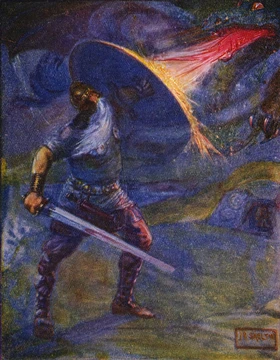
Fairyland
Mythical realm of fairies, ruled by a queen, in folklore.
Fairyland, also known as Faerie or Elfame in Scottish contexts, is a mythical realm in folklore inhabited by fays or fairies, sometimes ruled by a Fairy Queen. It appears in medieval ballads, witch trial records, and verse romances, often depicted as mysterious and otherworldly, with both benevolent and sinister aspects.
- type
- Mythical realm
- also_known_as
- Faerie, Elfame, Elfland, Elphyne
- ruler
- Fairy Queen (sometimes Queen of Elfame or Queen of Elfland)
- first_recorded_in
- Scottish witch trials (1576, 1588); medieval ballads
- associated_texts
- Thomas the Rhymer, Childe Rowland, Robert Sempill ballad (1583), Robert Graves alteration
- cultural_context
- Scottish folklore, fairy tales
Lore & Background
In folklore, Fairyland or Faerie is a fabulous land inhabited by fays or fairies, possibly ruled by a Fairy Queen. In Scottish contexts, it is also known as Elfame. Records of the Scottish witch trials reveal that many initiates claimed to have had congress with the 'Queen of Elfame' and her retinue. On November 8, 1576, midwife Bessie Dunlop of Dalry, Scotland, admitted to receiving tuition from Thomas Reid, a deceased barony officer, and from the queen of the 'Court of Elfame' that lay nearby; she was convicted and burned at the stake. Allison Peirson of Byre Hills, Fife, was burned as a witch in 1588 for conversing with the Queen of Elfame and for prescribing magic charms and potions. The same woman appears in a 1583 ballad by Robert Sempill, in which she is said to have been in a fairy-ride; Sempill's piece mentions 'Elphyne', glossed as 'Elfland' or 'Fairyland'.
Reader's Guide
Fairyland's significance lies in its role as a liminal space in Scottish folklore, bridging the human world and the supernatural. The witch trial records of Bessie Dunlop and Allison Peirson provide rare historical testimony of individuals claiming direct interaction with the Queen of Elfame, reflecting contemporary beliefs about fairy encounters and their association with witchcraft. Literary works such as Thomas the Rhymer and Childe Rowland further shaped the realm's portrayal, ranging from mystical and benevolent to sinister and wicked. The mysteriousness of Fairyland and its otherworldly powers fostered skepticism and distrust in many tales. Robert Graves's later alteration of the Thomas the Rhymer ballad, naming the queen as the 'Queen of Elphame', demonstrates the enduring adaptability of the concept. The realm's legacy persists in modern fantasy settings, such as the Feywild in Dungeons & Dragons, and in comparative studies of otherworlds like Tír na nÓg and Paristan.
Did You Know?
- Bessie Dunlop, a midwife from Dalry, Scotland, was burned as a witch in 1576 after claiming to have met the queen of the 'Court of Elfame'.
- Allison Peirson was burned as a witch in 1588 for conversing with the Queen of Elfame and prescribing magic charms.
- The ballad 'Thomas the Rhymer' features a title character spirited away by a female being, identified by commentators as the Queen of Fairies.
- The fairy tale 'Childe Rowland' presents a particularly negative view of Fairyland.
More in English folklore 1-24
Spotted an error? Know more?
This is a living reference — every entry is fact-audited, and reader corrections feed straight into our audit queue. Suggest an edit · See this site's audit record