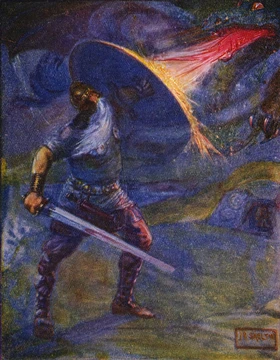
Earl Brand
Pseudo-historical English ballad of doomed lovers.
Earl Brand is the title figure of a pseudo-historical English ballad (Child 7, Roud 23). The ballad exists in multiple variants, with the hero sometimes named Earl Brand, Lord Douglas, or Lord William, and the heroine sometimes called Lady Margaret. The story involves a lovers' flight, betrayal, a fatal fight, and the heroine's death from sorrow.
- field
- Folk ballad
- known_for
- Pseudo-historical English ballad about doomed lovers
- type
- Child ballad 7
Lore & Background
The ballad's hero flees with his beloved, pursued by her father and kinsmen after a betrayal by a figure called Carl Hood. The hero kills the pursuers but is mortally wounded. He reaches his mother's house with the heroine, but upon his death she dies of sorrow. The ballad shares similarities with Child ballad 8, Erlinton, but Francis James Child separated them because in Earl Brand the assailants are the heroine's kin, while in Erlinton they are strangers.
Reader's Guide
Earl Brand is significant as a representative of the tragic lover-flight ballad type, preserved in multiple variants across England and Scandinavia. Its pseudo-historical nature and connection to figures like Odin (through the malicious Carl Hood) give it folkloric depth. The ballad's ending, with flowers growing from the lovers' grave, is a widespread motif found in many unrelated ballads and tales, including the legend of Tristan and Iseult, though no evidence shows it originated in the romances. The ballad's influence extends to visual art: Frederick William Burton drew upon a Danish variant for his painting 'Meeting on the Turret Stairs'. The ballad's legacy lies in its enduring narrative of doomed love and its place within the Child ballad canon, where it is distinguished from the similar but happier Erlinton.
Did You Know?
- The hero may be named Earl Brand, Lord Douglas, or Lord William in different variants.
- A figure called Carl Hood may betray the lovers; in Scandinavian variants he appears as a malicious figure of Odin or Woden.
- Many variants end with flowers growing from the lovers' grave, a motif found in ballads across Europe and parts of Asia.
- Frederick William Burton drew upon a Danish ballad of this type for his painting 'Meeting on the Turret Stairs'.
More in English folklore 1-24
Spotted an error? Know more?
This is a living reference — every entry is fact-audited, and reader corrections feed straight into our audit queue. Suggest an edit · See this site's audit record