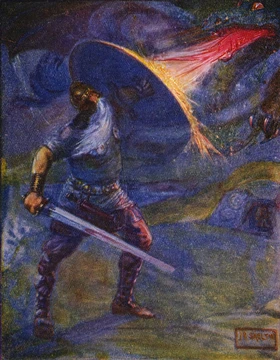
Dun Cow
A grey-brown cow of English folklore, tied to heroes, saints, and pubs.
The Dun Cow is a common motif in English folklore, appearing in legends across several counties. The term 'dun' refers to a dull shade of brownish grey, and the cow is often depicted as a giant, savage, or miraculous beast associated with local heroes and founding stories.
- type
- Folklore motif
- region
- England (Warwickshire, Lancashire, Durham, Bristol)
- associated_hero
- Guy of Warwick
- associated_saint
- Saint Cuthbert
- known_for
- Appearing in legends of Dunsmore Heath, Whittingham, Durham, and Bristol; linked to heraldic badges and pub names
- notable_relic
- Narwhal tusk exhibited at Warwick Castle as a rib of the Dun Cow
Lore & Background
On Dunsmore Heath in Warwickshire, the Dun Cow was said to be a savage beast slain by Guy of Warwick. A large narwhal tusk is still exhibited at Warwick Castle as one of its ribs. The fable held that the cow belonged to a giant and was kept on Mitchell's Fold, Shropshire, where its milk was inexhaustible until an old witch enraged it by trying to fill a sieve. The cow then wandered to Dunsmore Heath, where Guy of Warwick killed it. Isaac Taylor suggested the name 'dun cow' is a corruption of 'Dena Gau' (Danish region), implying Guy's feat may represent a victory over the Danes.
A similar legend applies to Dun Cow Rib Farm in Whittingham, Lancashire, where a large rib embedded in a wall supposedly came from a giant dun cow that gave milk freely until an old witch asked it to fill a riddle. An alternative legend claims the cow's milk saved locals from the Plague and that it was buried at Cow Hill. The rib is probably from a whale or Bronze Age aurochs.
In Durham, a 12th-century chronicler recounts that Saint Cuthbert's bier halted at Warden Law and would not move. After a fast, the saint instructed a monk to take the coffin to Dun Holm. Monks later met a milkmaid seeking her lost dun cow at Dun Holm, followed her, and founded Durham Cathedral on that spot. In Bristol, a 'Dun Cow bone' at St Mary Redcliffe was long regarded as a rib of George of Warwick but is actually a whale rib from Cabot's expedition.
Reader's Guide
The Dun Cow motif appears across English folklore, linking local legends of giant or miraculous cows to heroes, saints, and place-names. In Warwickshire, the cow slain by Guy of Warwick is commemorated by a narwhal tusk at Warwick Castle, while Isaac Taylor's linguistic theory suggests the legend may encode a historical conflict with Danes. In Lancashire, the cow's rib at Dun Cow Rib Farm and its association with plague survival show how folklore adapts to local needs. The Durham foundation legend uses the dun cow as a divine sign guiding Saint Cuthbert's followers to build the cathedral. The motif also appears in heraldry: Cardinal Wolsey noted a dun cow badge in the arms of Thomas Boleyn, seen as a portent for Anne Boleyn's marriage to Henry VIII. Public houses named The Dun Cow are widespread, including historic examples in Shrewsbury (built circa 1085) and Sedgefield, visited by Tony Blair and George W. Bush in 2003. A music hall song, 'When the Old Dun Cow Caught Fire,' popularized the name further. The motif's persistence across centuries—from medieval chronicles to modern pubs—demonstrates its deep roots in English cultural memory, though its origins remain disputed between literal beast, heraldic symbol, and linguistic corruption.
Did You Know?
- A narwhal tusk is exhibited at Warwick Castle as one of the ribs of the Dun Cow.
- Isaac Taylor suggested 'dun cow' is a corruption of 'Dena Gau', meaning Danish region.
- A pub called The Dun Cow in Sedgefield was visited by Tony Blair and George W. Bush in 2003.
- The Dun Cow bone in Bristol's St Mary Redcliffe is actually a whale rib from Cabot's 1497 expedition.
More in English folklore 1-24
Spotted an error? Know more?
This is a living reference — every entry is fact-audited, and reader corrections feed straight into our audit queue. Suggest an edit · See this site's audit record