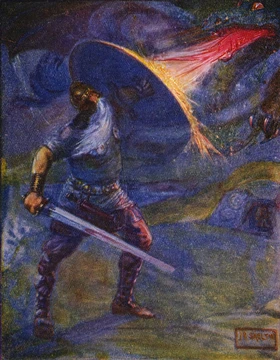
Devil Whale
Legendary whale-like monster that swallows ships and mimics an island.
The Devil Whale is a legendary demonic whale-like sea-monster, sometimes depicted as a sea-turtle, of enormous size that could swallow entire ships. According to myths, it resembles an island when sleeping, and unsuspecting sailors who land on its back and start a fire awaken the creature, which then attacks and drags the ship to the bottom of the sea. This association led Christianity to link the whale with the Devil.
- field
- Legendary sea-monster
- known_for
- Resembling an island, swallowing ships, and being associated with the Devil in Christianity
- first_appearance
- Sindbad the Sailor
Lore & Background
The Devil Whale appears in the story of Sindbad the Sailor, where on his First Voyage from Baghdad and Basra, he encounters a whale mistaken for an island. This incident has been compared to whales described by Pliny and Solinus, covering four jugera, and the pristis sea-monster of 200 cubits long. Al Kazwini tells a similar tale of a colossal tortoise, and such Eastern stories are probably the original of the whale-island in the Irish travel-romance of St Brandan.
Reader's Guide
The Devil Whale's significance lies in its enduring presence in folklore and literature, serving as a symbol of deception and danger. The story of sailors mistaking a sleeping whale for an island, only to be dragged to the depths when they light a fire, has been retold across cultures and centuries. Early explorer Saint Brendan the Navigator reportedly landed on a gigantic whale on Easter Sunday, and his monks' fire caused the 'island' to swim away. Guillaume le Clerc, in his 13th-century Bestiaire, describes the monster Cetus, which deceives sailors with its sand-like back. The legend gained modern resonance through the sinking of the real-life American whaleship Essex by a giant sperm whale in 1820, inspiring depictions in literature and film, including Herman Melville's Moby-Dick and Walt Disney's Pinocchio. The Devil Whale name was also used by Japanese whalers for the California grey whale due to the danger in hunting it.
Did You Know?
- The Devil Whale is sometimes depicted as a sea-turtle in some legends.
- Christianity began associating the whale with the Devil because of the Devil Whale myth.
- The story of the Devil Whale appears in Sindbad the Sailor.
- The sinking of the real-life American whaleship Essex by a giant sperm whale in 1820 inspired many modern legends behind the Devil Whale.
More in English folklore 1-24
Spotted an error? Know more?
This is a living reference — every entry is fact-audited, and reader corrections feed straight into our audit queue. Suggest an edit · See this site's audit record